.png)

The recent approval of Peru’s National Infrastructure Plan 2026–2031 (PNI) marks an important milestone to organize and prioritize strategic investments that are critical for the country’s development. Aligned with the Peru 2050 Strategic Development Plan, the PNI prioritizes 72 projects with an investment envelope of more than S/ 144 billion, aimed at closing infrastructure gaps, boosting productivity and improving access to quality public services.

The portfolio covers high‑impact investments across transport, irrigation and agriculture, water and sanitation, electricity, health, education, telecommunications, tourism and culture, with a focus on strengthening national competitiveness and territorial connectivity. The Plan also introduces a more integrated management approach, moving from a purely prioritization‑oriented instrument to one that guides the full investment cycle through action plans, progress indicators and early‑warning mechanisms to help unblock stalled projects.
One of the most relevant innovations of the new PNI is the consolidation of a territorial approach that organizes infrastructure projects by macrozones (North, Center, Lima–Callao and South). This approach links infrastructure with the productive, logistics and social dynamics of each territory, recognizing that Peru’s development is not homogeneous and that investments must respond to differentiated regional realities.
The Plan also incorporates four dimensions of sustainable infrastructure—economic‑financial, social, institutional and environmental—and sets minimum technical conditions for including projects in the portfolio, seeking to ensure that prioritized investments are feasible, impactful and aligned with sustainability objectives. In addition, the update cycle of the Plan is extended from three to five years to give investors greater predictability and acknowledge the longer maturation times required for complex infrastructure projects.
Sinfranova has supported this shift by contributing to the development of Territorial Notes that inform the new National Infrastructure Plan, in collaboration with The Nature Conservancy (TNC) Peru, and with support from multilateral partners. These Territorial Notes provide strategic diagnoses for each macrozone, identifying productive potentials, infrastructure gaps, risks, anchor projects, and enabling conditions, and help align infrastructure portfolios with territorial opportunities through 2050.
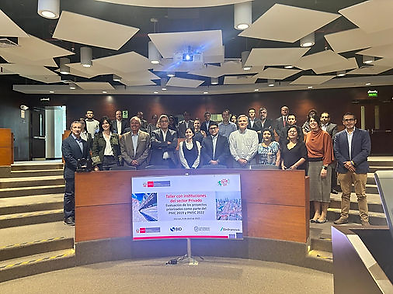
In parallel, Sinfranova, together with Universidad del Pacífico, evaluated the implementation of prioritized projects in previous national infrastructure plans (PNIC 2019 and PNISC 2022–2025). This work identified bottlenecks affecting project progress along the life cycle, particularly in project preparation, choice of execution mechanisms, and coordination during implementation, and generated recommendations to inform the design and implementation of future plans. These lessons have contributed to strengthening the new PNI’s focus on project maturation, portfolio management, and governance, with the ultimate goal of translating prioritized projects into tangible improvements in services and territorial development across Peru.